Note: This portfolio site was launched on 30th March 2025. More stories, resources, and portfolio updates will be added progressively as I move forward and subject to available personal time.

Appium MCP Simplified: Amplify Mobile Automation
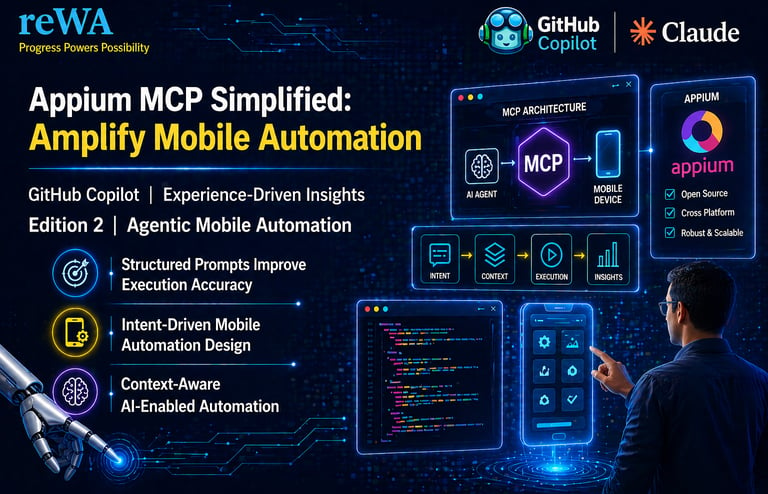
Appium MCP Simplified: Amplify Mobile Automation explains structured prompting techniques to improve execution accuracy, reduce ambiguity, and enable reliable, context-aware mobile automation using AI-enabled MCP-based workflows.
TECHNICAL
Kiran Kumar Edupuganti
4/26/20266 min read






Appium MCP Simplified: Amplify Mobile Automation
GitHub Copilot , Claude | Experience-Driven Insights
Edition -2
Open Source | Agentic Mobile Automation | Smarter Prompting & Usage
The portfolio reWireAdaptive, in association with the @reWirebyAutomation channel, presents an article on Appium MCP to enable Mobile Agentic Automation. This article, titled "Appium MCP Simplified: Amplify Mobile Automation", aims to build the Agentic Mobile Automation using Smart Prompting Strategy.
Introduction
In the previous edition, we explored how Appium MCP introduces a shift from script-based automation to intent-driven execution. The focus was on understanding the architecture, the role of MCP, and how automation transitions from rigid instruction-based scripts to more adaptive systems.
However, understanding the concept alone is not sufficient to realize the value of MCP. The real impact of MCP depends on how effectively engineers interact with it during execution. Unlike traditional automation, where behavior is controlled through code, MCP-based systems rely on prompts to define actions and outcomes.
This introduces a new dimension in automation design. The quality of automation is no longer dependent only on framework design and coding standards but also on how instructions are expressed. Poorly defined prompts can lead to inconsistent execution, while well-structured prompts enable predictable and reliable automation.
In real-world usage, this becomes a critical factor. Engineers who are used to deterministic scripting often expect the same behavior from MCP systems. However, MCP introduces controlled variability, where the system interprets intent and decides execution steps based on context. This requires a disciplined approach to prompting.
This article focuses on how prompting influences MCP-based automation, how it should be structured, and how engineers can use it effectively to build reliable automation systems.
Key Observations:
• Prompt Quality Directly Impacts Execution Accuracy
• MCP Introduces Controlled Variability In Execution
• Engineers Must Design Prompts, Not Just Write Instructions
• Prompting Becomes Part Of Automation Engineering Discipline
Why This Matters (Practical Perspective)
In traditional automation projects, execution behavior is deterministic. Engineers define each step explicitly, and the system follows those instructions exactly. While this provides control, it also creates rigidity and increases maintenance effort.
With MCP-based automation, the control model changes. The system interprets prompts and makes decisions during execution. This flexibility improves adaptability but introduces a dependency on how clearly the instructions are defined.
From practical experience, teams transitioning to MCP often face initial challenges due to poorly structured prompts. These prompts either lack clarity or do not define expected outcomes, leading to inconsistent execution results.
For example, a simple instruction such as “login to the application” may produce different execution paths depending on the application state. Without clear validation criteria, the system may complete the action without confirming success.
This highlights the importance of structured prompting. It ensures that the system understands both the action and the expected outcome. In large-scale automation environments, this becomes even more critical, as inconsistent execution reduces trust in automation systems.
Practical Impact:
• Improves Execution Consistency
• Reduces Ambiguity in Automation Behavior
• Enables Better Control Over AI-Driven Execution
• Minimizes Rework Due To Unclear Instructions
Core Concept / Problem Definition
The core problem in MCP-based automation is not execution capability but instruction clarity. Traditional automation systems rely on explicit scripting, where each step is predefined and executed without interpretation.
In MCP-based systems, execution depends on how the instruction is interpreted by the AI agent. This introduces a dependency on prompt quality. If the prompt is vague, incomplete, or ambiguous, the system may not execute as expected.
For example, a weak prompt such as “login to the app” does not define the required inputs, expected outputs, or validation logic. This results in execution that may complete without verifying correctness.
In contrast, a structured prompt clearly defines both action and outcome. This reduces ambiguity and improves execution reliability.
This problem becomes more visible in complex workflows where multiple steps and validations are required. Without structured prompts, execution may deviate from expected behavior.
Key Problems Identified:
• Ambiguity In Prompt Definition
• Missing Validation Logic
• Lack Of Execution Control
• Inconsistent Interpretation By AI Systems
Explanation (Detailed)
Prompting in MCP-based automation is not just about giving instructions. It is about designing inputs that guide the system to achieve a specific outcome. This requires a structured approach that combines clarity, validation, and context awareness.
A well-defined prompt typically includes three components: action, context, and validation. The action defines what needs to be performed, the context defines where or how it should be performed, and validation defines what success looks like.
For example, a structured prompt such as “from the home screen, navigate to settings, enable WiFi, and verify that the toggle is enabled” ensures that the system understands both execution flow and expected result.
Another important aspect is maintaining balance in prompt complexity. Overly generic prompts lack clarity, while overly detailed prompts may introduce unnecessary complexity. Engineers must design prompts that are precise but not excessive.
This approach shifts automation thinking from writing code to designing instructions. Engineers must understand how the system interprets prompts and structure them accordingly.
Key Principles:
• Define Intent Clearly
• Include Validation Criteria
• Maintain Logical Flow
• Avoid Unnecessary Complexity
Architecture / Flow
Prompting is closely tied to the MCP execution architecture. Understanding how prompts flow through the system helps engineers design effective instructions.
In MCP-based automation, the execution flow follows an iterative pattern. The AI agent interprets the prompt and sends structured instructions to the MCP server. The MCP server translates these into Appium commands, which are executed on the device. The device response is then analyzed and fed back to the AI agent for further decision-making.
This creates a continuous loop of execution and evaluation, allowing the system to adapt dynamically.
Unlike traditional automation, where execution is linear and predefined, MCP introduces dynamic execution where decisions are made during runtime. This improves adaptability but requires clear instructions to maintain consistency.
The effectiveness of this flow depends heavily on prompt quality. Well-structured prompts ensure that each iteration aligns with the intended outcome.
Flow Characteristics:
• Iterative Decision-Making
• Context-Driven Execution
• Dynamic Action Selection
• Continuous Validation
Practical Implementation / Usage
From practical usage, structured prompting patterns significantly improve execution reliability. Engineers should adopt consistent patterns based on scenario complexity.
For simple scenarios, combining action and validation in a single prompt works effectively. For complex workflows, step-based prompting provides better control and clarity. Context-aware prompts ensure that execution starts from the correct application state.
Engineers should also refine prompts iteratively. Initial prompts may not always produce expected results, but continuous refinement based on execution feedback improves accuracy over time.
Another important aspect is maintaining consistency across prompts. Using standardized patterns across test scenarios ensures predictable behavior and simplifies debugging.
Effective Usage Practices:
• Combine Action and Validation
• Use Step-Based Prompts For Complex Flows
• Include Context Where Required
• Refine Prompts Based On Execution Feedback
Comparison (Traditional vs MCP Prompting)
Traditional automation relies on explicit scripting, where engineers define each step and control execution completely. This approach ensures predictability but increases maintenance effort.
MCP-based automation introduces a different model, where execution is guided by prompts. This allows the system to adapt based on context but requires well-structured instructions.
The comparison highlights a shift in how automation is designed. Instead of focusing on code, engineers must focus on instruction clarity and execution control.
This change impacts debugging, maintenance, and scalability of automation systems.
Key Differences:
• Script-Based Execution vs Intent-Based Execution
• Fixed Locator Strategy vs Dynamic Locator Strategy
• Deterministic Flow vs Adaptive Flow
• Code-Driven Logic vs Prompt-Driven Logic
Enterprise Reality / Constraints
In enterprise environments, adopting MCP-based prompting requires careful consideration of constraints such as security, compliance, and system integration.
Many organizations restrict external AI integrations due to data security concerns. This limits the direct use of MCP in production environments. However, the principles of structured prompting can still be applied within existing frameworks.
Teams can improve automation design by focusing on clarity, validation, and structured test definitions, even without MCP.
Additionally, organizations must consider performance and cost implications when using AI-driven systems. Prompting should be efficient and optimized to avoid unnecessary overhead.
A phased adoption approach is recommended, where teams experiment with MCP and gradually integrate concepts into production systems.
Enterprise Considerations:
• Security And Compliance Constraints
• Cost of AI Usage
• Performance Implications
• Controlled Adoption Strategy
Human-in-the-Loop
Human involvement remains essential in MCP-based automation. While AI assists in execution, engineers are responsible for ensuring correctness and reliability.
Engineers must continuously evaluate execution results, refine prompts, and ensure that automation aligns with business requirements. AI systems can interpret instructions, but they require guidance to handle application-specific scenarios accurately.
Human-in-the-loop ensures that automation systems remain controlled and predictable. It also enables continuous improvement through feedback and refinement.
Over time, this creates a stable system where prompting strategies evolve based on real usage.
Human Responsibilities:
• Validate And Refine Prompts
• Ensure Correctness of Execution
• Guide System Behavior
• Maintain Automation Quality



Stay tuned for the next article from rewireAdaptive portfolio
This is @reWireByAutomation, (Kiran Edupuganti) Signing Off!
With this, @reWireByAutomation has published a “Appium MCP Simplified: Amplify Mobile Automation."