Note: This portfolio site was launched on 30th March 2025. More stories, resources, and portfolio updates will be added progressively as I move forward and subject to available personal time.

Appium MCP Simplified: Building the Foundation for AI-Driven Mobile Automation
Appium MCP Simplified: Foundation explains the shift from script-based mobile automation to intent-driven execution using MCP, enabling context-aware interaction, reduced maintenance, and scalable automation through AI-assisted workflows.
TECHNICAL
Kiran Kumar Edupuganti
4/11/20266 min read






Appium MCP Simplified: Building the Foundation for AI-Driven Mobile Automation
GitHub Copilot , Claude | Experience-Driven Insights
Edition -1
Open Source | From Script Driven to Intent Driven Automation in Mobile | Enabling Agentic
The portfolio reWireAdaptive, in association with the @reWirebyAutomation channel, presents an article on Appium MCP to enable Mobile Agentic Automation. This article, titled "Appium MCP Simplified: Building the Foundation for AI-Driven Mobile Automation", aims to build the Appium MCP Foundation.
Introduction
Mobile automation has evolved significantly over the years. Appium-based frameworks today are no longer simple scripts. They are built using structured design patterns such as Page Object Model (POM), BDD with Cucumber, TestNG integration, reusable utilities, and CI/CD pipelines. These advancements have enabled teams to scale automation across large applications and integrate testing into continuous delivery workflows.
However, despite these improvements, one fundamental limitation continues to exist.
Automation is still instruction-driven.
In a typical Appium setup, every interaction with the mobile application is explicitly defined by the test engineer. This includes identifying elements using locators, defining the sequence of actions, handling synchronization, and validating outcomes. Each step is predefined and tightly coupled with the UI structure.
This approach provides control and predictability, but it also introduces fragility. Even minor changes in the application, such as updates to resource identifiers, UI restructuring, or dynamic behavior, can break multiple test cases. Over time, automation becomes maintenance-heavy, and teams spend more effort fixing scripts than expanding coverage.
The core issue is not the tooling but the design approach. Traditional automation focuses on how actions are performed, rather than what needs to be achieved. Modern applications, which are dynamic and frequently updated, require automation systems that can understand context and adapt accordingly.
This gap between execution and understanding is what drives the need for a new approach — and that is where Appium MCP comes into the picture.
Why This Matters in Real Automation Projects
Mobile automation frameworks built on Appium are widely used across enterprise systems. Teams invest significant effort in designing scalable frameworks, integrating CI/CD pipelines, and building reusable utilities. Despite these efforts, a common challenge persists — automation stability and maintainability degrade over time.
One of the primary reasons for this is the tight coupling between automation scripts and UI structure. Every interaction in traditional automation depends on locators and predefined flows. When the application evolves, these dependencies become points of failure.
For example, a simple UI change, such as modifying a layout, updating the element hierarchy, or introducing dynamic rendering, can break multiple test cases. Engineers are then required to revisit scripts, update locators, and revalidate flows. This creates a continuous maintenance cycle.
Another important limitation is the absence of context awareness. Automation scripts execute instructions without understanding whether the application is in the expected state. They do not validate if the correct screen is loaded or if the element being interacted with represents the intended functionality.
As applications scale, these issues become more visible:
• Increased effort in maintaining locators
• Repeated debugging cycles
• Reduced confidence in automation results
• Slower response to application changes
These challenges indicate that the limitation lies not in the framework's capabilities but in the automation design approach.
What is Appium MCP?
Appium MCP introduces a new layer in the automation architecture by enabling interaction between AI systems and mobile applications through a standardized protocol.
At its core, MCP acts as a context-aware intermediary between the AI agent and the Appium execution engine. It exposes Appium capabilities as structured tools and provides UI context that can be interpreted by AI systems.
Unlike traditional automation, where scripts directly interact with Appium, MCP introduces a layered interaction model. The user provides an intent, the AI system interprets that intent, and MCP translates it into executable commands.
This architecture separates responsibilities clearly:
• AI agent focuses on reasoning and decision-making
• MCP server handles translation and context delivery
• Appium executes commands on the device
This separation enables flexibility. Appium remains unchanged as the execution engine, while MCP enables intelligent interaction without modifying existing frameworks.
The result is an architecture where automation becomes more adaptable and less dependent on rigid script definitions.
Core Concept: Script-Based to Intent-Based Automation
The transformation introduced by MCP is not incremental — it is conceptual.
Traditional automation operates on a script-based model, where every action is predefined. Engineers explicitly define each interaction, making automation predictable but rigid. This model works well in stable environments but struggles in dynamic applications.
In contrast, MCP introduces an intent-based model, where the focus shifts from defining steps to defining outcomes.
For example, instead of writing multiple lines of code to perform a login operation, the user provides an instruction such as:
"Log in to the application and validate the dashboard."
This instruction is interpreted by the AI system, which uses MCP to understand the application context. Based on the UI hierarchy and available elements, the system identifies relevant components and determines the execution sequence.
This shift changes the role of automation:
• From executing predefined steps
• To interpret goals and achieve outcomes
It reduces the need for repetitive coding and enables automation to adapt to UI changes dynamically.
This is the foundation of intelligent automation systems.
Appium MCP Architecture
The architecture of Appium MCP is designed to decouple reasoning, translation, and execution.
It consists of four primary components:
• Mobile Application – provides UI structure and state
• Appium Server – acts as the execution engine
• MCP Server – acts as a translation and context layer
• AI Agent – performs reasoning and decision-making
The execution flow is iterative rather than linear. The AI agent sends a request to MCP, which translates it into Appium commands. The device responds with an updated UI state, which is again analyzed by the AI agent for further actions.
This creates a loop:
AI → MCP → Appium → Device → MCP → AI
This iterative flow allows the system to:
• Evaluate current state
• Adjust actions dynamically
• Respond to unexpected UI changes
The architecture ensures that intelligence is layered on top of execution, rather than embedded within it. This makes the system modular and extensible.
Key Capabilities (Practical Perspective)
Appium MCP enhances automation by introducing capabilities that address real-world challenges.
Intelligent Element Detection
Instead of relying on fixed locators, MCP analyzes the UI hierarchy at runtime. It evaluates attributes such as accessibility identifiers, resource IDs, text, and relationships between elements.
This reduces dependency on brittle locators and improves resilience to UI changes.
Natural Language Automation
MCP enables automation through natural language instructions. Engineers can describe actions in simple terms, and the system interprets and executes them.
This reduces the effort required to write scripts and allows faster test creation.
Dynamic Locator Strategy
MCP selects the most appropriate locator strategy based on context. Instead of hardcoding locators, the system dynamically determines the best approach for element identification.
This improves maintainability and reduces manual intervention.
Device and Application Control
MCP supports interaction with the application lifecycle and device state, including launching apps, resetting sessions, capturing screenshots, and performing gestures.
This ensures that automation can manage complete execution scenarios.
Cross-Platform Execution
MCP enables the same intent to be executed across Android and iOS platforms. It abstracts platform-specific differences and allows consistent automation behavior.
These capabilities collectively transform automation from static execution to adaptive interaction.
Appium MCP vs Traditional Appium
The difference between traditional Appium and MCP-based automation lies in the design approach.
Traditional automation focuses on explicit control, where engineers define every step. This provides precision but requires continuous maintenance.
MCP-based automation introduces adaptability by leveraging AI for decision-making. It reduces dependency on static scripts and enables dynamic interaction with the application.
Key differences include:
· Execution model (script vs intent)
· Locator strategy (manual vs dynamic)
· Maintenance effort (high vs reduced)
· Adaptability (low vs high)
· Decision Making (None vs AI-driven)
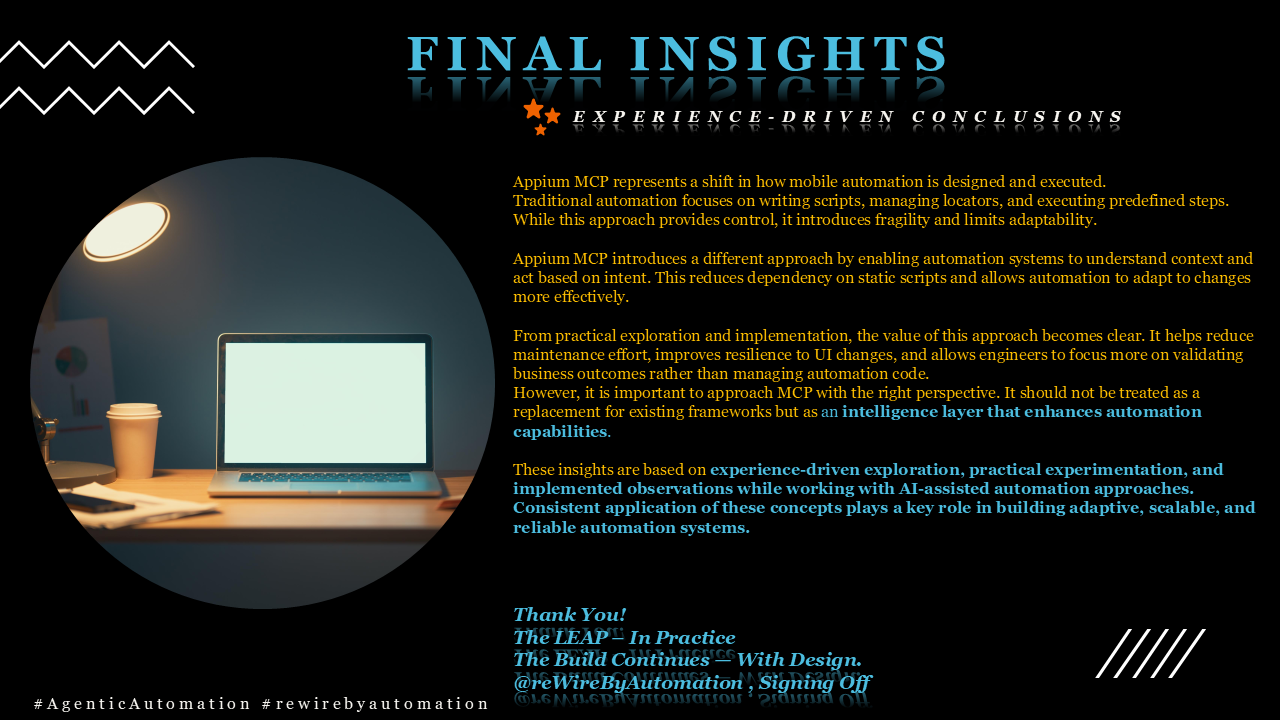
This comparison highlights that MCP is not just an enhancement but a shift in automation design philosophy.
Enterprise Reality
While MCP introduces powerful capabilities, its adoption in enterprise environments requires careful evaluation.
Many organizations operate under strict security and compliance constraints. External AI integrations may not be allowed, and data exchange with external systems may be restricted.
Additionally, MCP introduces dependencies on AI systems, which may involve latency and cost considerations.
In such environments, a practical approach is to use MCP selectively:
• For learning and experimentation
• For proof-of-concept implementations
• For exploring new automation design approaches
At the same time, teams can apply MCP concepts within existing frameworks:
• Designing intelligent locator strategies
• Implementing context-aware validations
• Reducing script rigidity
This ensures that organizations benefit from MCP concepts without full adoption.


Stay tuned for the next article from rewireAdaptive portfolio
This is @reWireByAutomation, (Kiran Edupuganti) Signing Off!
With this, @reWireByAutomation has published a “Appium MCP Simplified: Building the Foundation for AI-Driven Mobile Automation."