Note: This portfolio site was launched on 30th March 2025. More stories, resources, and portfolio updates will be added progressively as I move forward and subject to available personal time.

AI-Enabled Automation: Amplifying Framework Engineering | Open-Source Stack
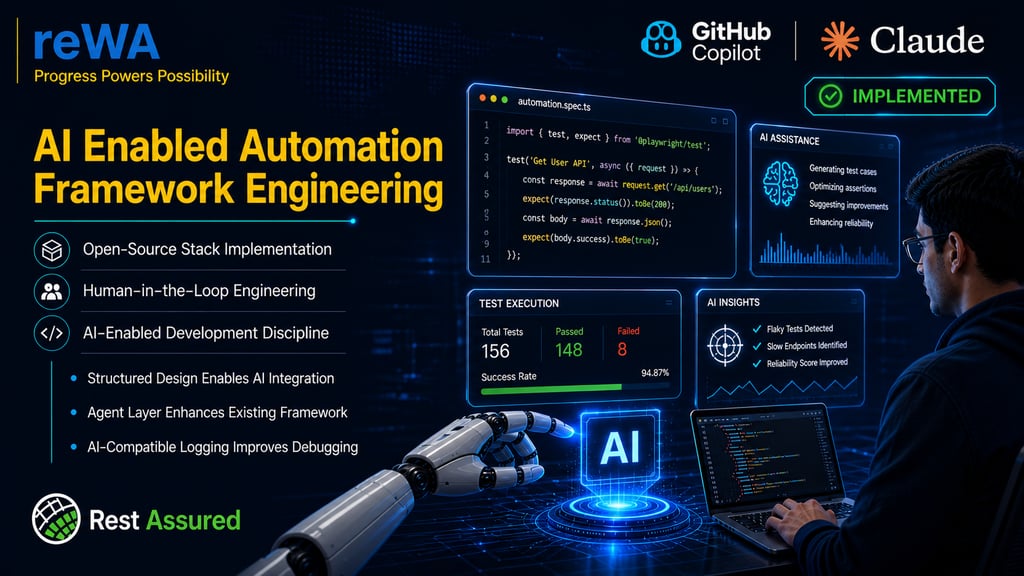
AI-enabled automation framework engineering for open-source stack demonstrates structured engineering, agent layer integration, and AI-compatible logging to improve execution stability, validation consistency, and reduce manual debugging effort.
TECHNICAL
Kiran Kumar Edupuganti
5/9/20266 min read






AI-Enabled Automation: Amplifying Framework Engineering | Open-Source Stack
GitHub Copilot , Claude | Experience-Driven Insights
Open Source Stack Implementation
Human-in-the-Loop Engineering | AI-Enabled Development Discipline
The portfolio reWireAdaptive, in association with the @reWirebyAutomation channel, presents an article on Automation Framework Engineering using AI. This article, titled "AI-Enabled Automation: Amplifying Framework Engineering | Open-Source Stack", aims to build the Automation Framework using intent driven and pattern development methodology.
Introduction
Automation frameworks have matured over time with well-established patterns such as layered architecture, reusable components, and CI/CD integration. These practices have enabled teams to build scalable and maintainable automation systems.
However, one significant shift is now shaping how these frameworks are designed and evolved — the introduction of AI into the development process. The focus is no longer limited to writing reusable code or structuring layers effectively. Instead, the emphasis is on how intelligently the framework can support development, execution, and analysis.
AI does not replace the foundation of automation frameworks. The core layers, patterns, and design principles remain essential. What changes is how these systems are built, extended, and interacted with. AI introduces the ability to interpret intent, assist in development, and provide contextual insights during execution.
This creates a new dimension in framework engineering. The goal shifts from building automation systems that execute reliably to building systems that can adapt, guide, and evolve with minimal manual intervention.
This transformation requires a disciplined approach. Without structure, AI-driven development can lead to inconsistency. With a well-defined architecture, it becomes an enabler of scalability and clarity.
This article focuses on how AI influences framework implementation, how existing designs can be enhanced, and how structured engineering practices help in building reliable automation systems in the AI-enabled era.
Implementation Shift: From Traditional Development to AI-Assisted Engineering
Traditional framework development is based on deterministic design. Engineers define structure, write reusable components, and control execution through explicit code. While this approach provides clarity and control, it also introduces limitations in adaptability and speed of development.
With AI-assisted engineering, the development approach evolves. Engineers are no longer focused only on writing code but also on guiding how the system should interpret and assist in building components. AI can support in generating test logic, suggesting improvements, and accelerating repetitive tasks.
This does not eliminate the need for engineering discipline. In fact, it increases the importance of having a well-defined structure. AI works effectively when the system is organized and predictable.
The shift can be understood as:
• From Code-Driven Development To Assisted Development
• From Manual Implementation To Guided Generation
• From Static Logic To Context-Aware Suggestions
• From Reactive Maintenance To Proactive Design
This transformation improves development speed and reduces effort, but it also requires engineers to think differently. Instead of focusing only on implementation, they must focus on designing systems that can work effectively with AI assistance.
The result is not just faster development, but more structured and adaptable automation systems.
AI-Assisted Implementation Across Framework Layers
AI can be applied across different layers of an automation framework, enhancing both development and execution. The key is to integrate AI in a way that complements existing architecture rather than disrupting it.
In the client and resource layers, AI can assist in generating API interactions based on existing definitions. It can analyze request structures and help create reusable components.
In the business and BDD layers, AI can support scenario creation and improve readability by aligning automation logic with business behavior. This reduces the gap between technical implementation and functional understanding.
In the reporting layer, AI can analyze execution data and provide insights that are not immediately visible through standard logs. This improves debugging and helps identify patterns in failures.
Across these layers, AI enables:
• Faster Creation Of Reusable Components
• Improved Consistency In Test Design
• Better Alignment Between Business And Technical Layers
• Enhanced Analysis Of Execution Results
The key is not to depend entirely on AI, but to use it as a supporting mechanism within a well-structured framework.
Agent Layer: Extending Existing Framework Architecture
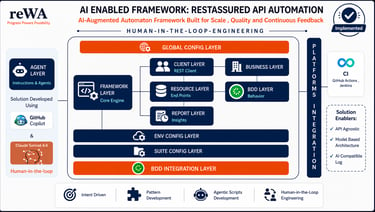
The introduction of an agent layer adds a new dimension to automation frameworks. This layer sits on top of existing layers and acts as an interaction point between the engineer and the system.
Unlike traditional execution models where scripts directly control behavior, the agent layer allows interaction through instructions or intent. It interprets these instructions and coordinates execution across different layers of the framework.
This does not replace existing layers such as client, resource, or business layers. Instead, it enhances them by providing an intelligent interface for interaction.
The agent layer enables:
• Instruction-Driven Interaction With The Framework
• Dynamic Interpretation Of Execution Flow
• Better Utilization Of Existing Framework Components
• Reduced Dependency On Rigid Script Definitions
This layer acts as a bridge between human intent and system execution. It allows engineers to interact with the framework at a higher level while still relying on the underlying structured architecture.
When implemented correctly, the agent layer enhances usability without compromising control.
Structured Engineering in the AI-Enabled Era
AI introduces flexibility, but flexibility without structure leads to inconsistency. This makes structured engineering more important than ever.
A well-designed framework provides clear boundaries between layers, defined responsibilities, and predictable execution flow. This structure enables AI to function effectively, as it can operate within known constraints and patterns.
Without structure, AI-generated outputs may vary significantly, leading to unreliable automation behavior. With structure, AI becomes a powerful tool that enhances consistency and scalability.
Structured engineering ensures:
• Clear Separation Of Components Across Layers
• Predictable Behavior In Automation Execution
• Easier Integration Of AI Capabilities
• Improved Maintainability Over Time
This approach allows teams to leverage AI without losing control over system behavior. It ensures that automation remains stable while benefiting from AI-assisted development.
In this context, structure is not a limitation. It is an enabler that allows AI to be used effectively.
Implementation Outcome: AI-Enabled Automation Model in Practice
Applying structured engineering principles with AI integration results in a more stable and predictable automation system. When the framework is designed with clear separation of layers, controlled configuration, and consistent execution patterns, AI can operate effectively within defined boundaries.
An important outcome of this approach is the ability to build an AI-enabled API automation model that focuses on consistency in validation and execution stability. Instead of relying on manual debugging and repeated analysis, the system leverages structured logs and AI-compatible outputs to interpret execution behavior.
Validation becomes more reliable because the framework ensures that checks are aligned with defined patterns and expected outcomes. This reduces ambiguity in test results and improves confidence in execution.
Another key improvement is in debugging. Traditional debugging often involves manually reviewing logs, identifying failure points, and tracing execution flow. With AI-compatible logging, the system provides structured data that can be interpreted efficiently, reducing the need for manual investigation.
This reduces the need for manual, post-failure debugging and improves visibility into execution behavior. The framework is designed to surface relevant insights rather than requiring engineers to search through logs and trace execution step by step.
The above approach is demonstrated through an implemented automation system for REST web services using AI-enabled design principles. The same principles have also been applied in a Playwright-based solution, where an initial glimpse was shared earlier. A more detailed perspective on that implementation will be presented separately.
Observed Outcomes:
• Consistent Validation Across Test Scenarios
• Improved Stability Of Test Suites
• Reduced Dependency On Manual Debugging
• Faster Identification Of Execution Issues
• Better Utilization Of AI-Compatible Logs
This demonstrates that when AI is integrated with a structured framework, the result is not just faster execution, but more reliable and maintainable automation systems.
Refer to the AI-Enabled Layered Architecture for Open Source Stack For Instance RestAssured Automation Solution Implementation
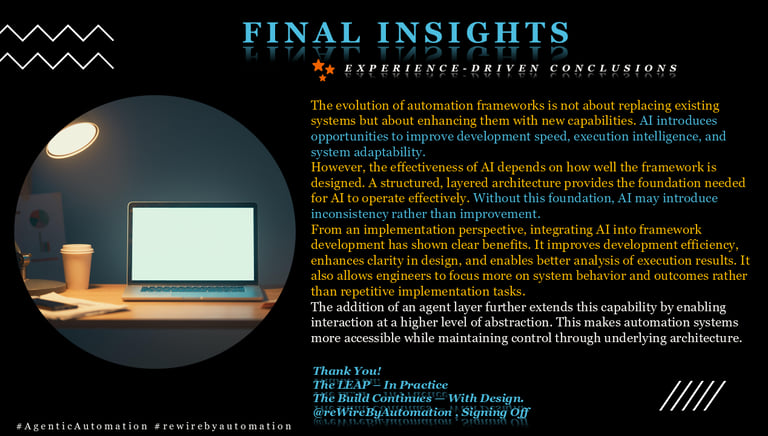


Stay tuned for the next article from rewireAdaptive portfolio
This is @reWireByAutomation, (Kiran Edupuganti) Signing Off!
With this, @reWireByAutomation has published a “AI-Enabled Automation: Amplifying Framework Engineering | Open-Source Stack"