Note: This portfolio site was launched on 30th March 2025. More stories, resources, and portfolio updates will be added progressively as I move forward and subject to available personal time.

Agent Optimization: Designing a Premium-First, Standard-Safe Workflow
Agent Optimization explores managing premium request caps in GitHub Copilot, sharing practical strategies to balance premium and standard models for reliable, budget-conscious AI-enabled (Agentic) automation development.
TECHNICAL
Kiran Kumar Edupuganti
2/14/20264 min read






Agent Optimization: Designing a Premium-First, Standard-Safe Workflow
GitHub Copilot | Experience-Driven Insights
The portfolio reWireAdaptive, in association with the @reWirebyAutomation channel, presents an article on Agent Design. This article, titled "Agent Optimization: Designing a Premium-First, Standard-Safe Workflow", aims to explore and adopt Agent Optimization in the AI-Enabled Automation Development / Agentic Automation Pattern.
Introduction
AI-enabled development has become deeply integrated into modern workflows. Whether working in VS Code, IntelliJ IDEA, PyCharm, Copilot Chat, or GitHub.com, the Copilot Pro license provides access to premium capabilities that enhance reasoning, context handling, and code generation quality.
However, one practical constraint becomes visible quickly: premium requests are capped monthly. In the Copilot interface, the “View quota usage” section clearly shows premium requests consumption. Once the quota reaches 100%, the system prompts users to switch to standard models.
This introduces an important engineering question:
How do we optimize agent productivity within a premium request budget while maintaining development quality?
This article shares my observations and practical strategies for balancing premium usage, standard models, and engineering discipline in AI-enabled automation development.
Understanding Premium Requests in Practice
In Copilot Pro — and similarly in Enterprise mode — premium models are tied to a monthly cap of premium requests. The “View quota usage” section clearly reflects premium request consumption across interfaces, including IDE integrations (VS Code, IntelliJ IDEA), Copilot Chat, and GitHub.com. Once the quota reaches 100%, premium access is restricted, and the workflow shifts to standard models. Although licensing structures may differ between Pro and Enterprise environments, the operational pattern remains the same: premium reasoning is capped, and sustained productivity depends on disciplined usage.
In day-to-day automation development, premium requests can be consumed faster than expected. Deep debugging, architectural discussions, repeated retries, large-context prompts, and multi-step reasoning quickly draw down the available quota.
This makes it necessary to treat premium usage not as unlimited assistance, but as a constrained optimization resource.
Observations from Practical Usage
Based on my experience:
Premium requests are consumed quickly when used casually or repeatedly without structured prompting.
Standard models are less agentic in handling large context, complex instructions, or multi-step reasoning. They often struggle to maintain alignment with detailed constraints in automation projects.
Standard models perform reasonably well for single-line instructions or small, localized tasks, but they are not suited for deep problem-solving or framework-level decisions.
Since premium requests are tied to a Pro subscription and effectively represent a budgeted resource, usage must be conservative and intentional.
These observations led me to rethink how premium requests should be used from an agent optimization perspective.
Part 1: Best Practices for Working with Premium Requests
1. Treat Premium Requests as Deep-Work Tokens
Premium requests should be reserved for tasks that require:
Architecture or framework design
Multi-file reasoning
Complex debugging
Pattern standardization
Constrained multi-step problem solving
Using a premium for trivial tasks reduces its value. The highest ROI comes from applying it to reasoning-intensive problems.
2. Reduce Retry Burn
A major source of premium waste is repeated “regenerate” cycles caused by vague prompts.
Instead:
Provide structured, complete prompts upfront.
Define constraints clearly.
Limit scope (“update this class only”, “do not introduce new dependencies”).
Better input reduces retry consumption.
3. Use Premium for Planning, Standard for Execution
An effective pattern:
Use premium to generate:
A design plan
File structure
Responsibility separation
Reusable patterns
Then use standard models to:
Implement small methods
Write repetitive test cases
Refactor minor blocks
Adjust naming or formatting
This preserves the premium for reasoning while using the standard for mechanical work.
4. Build Instruction Assets to Preserve Premium
Repeatedly explaining project standards consumes premium unnecessarily.
Create persistent instruction artifacts:
Repository-level Copilot instructions
Framework conventions
Assertion standards
Logging patterns
Retry strategies
When instructions are stable, premium requests become more predictable, and fewer retries are needed.
Part 2: Extracting Maximum Value from Standard Models
Standard models should not be forced into deep-reasoning roles. Instead, adapt your workflow to their strengths.
1. Shrink the Problem
Break complex tasks into small, isolated units:
Write one method.
Refactor one function.
Convert one JSON to a POJO.
Generate one locator.
Standard models perform better when the task is precise and bounded.
2. Prefer Example-Based Guidance
Instead of giving long descriptive constraints, provide a working example and ask for pattern replication.
Example-driven prompts improve alignment even in standard models.
3. Avoid Large Context Prompts
Standard models degrade when overloaded with:
Multi-file architecture
Long instructions
Many constraints at once
Keep prompts short and objective-focused.
Part 3: A Sustainable Agent Optimization Routine
To balance productivity and budget constraints:
Use premium early for structural and architectural decisions.
Reserve premium mid-cycle for blockers and debugging.
Use a standard for day-to-day incremental work.
Track what consumes premium the fastest.
Avoid casual or experimental use during critical project phases.
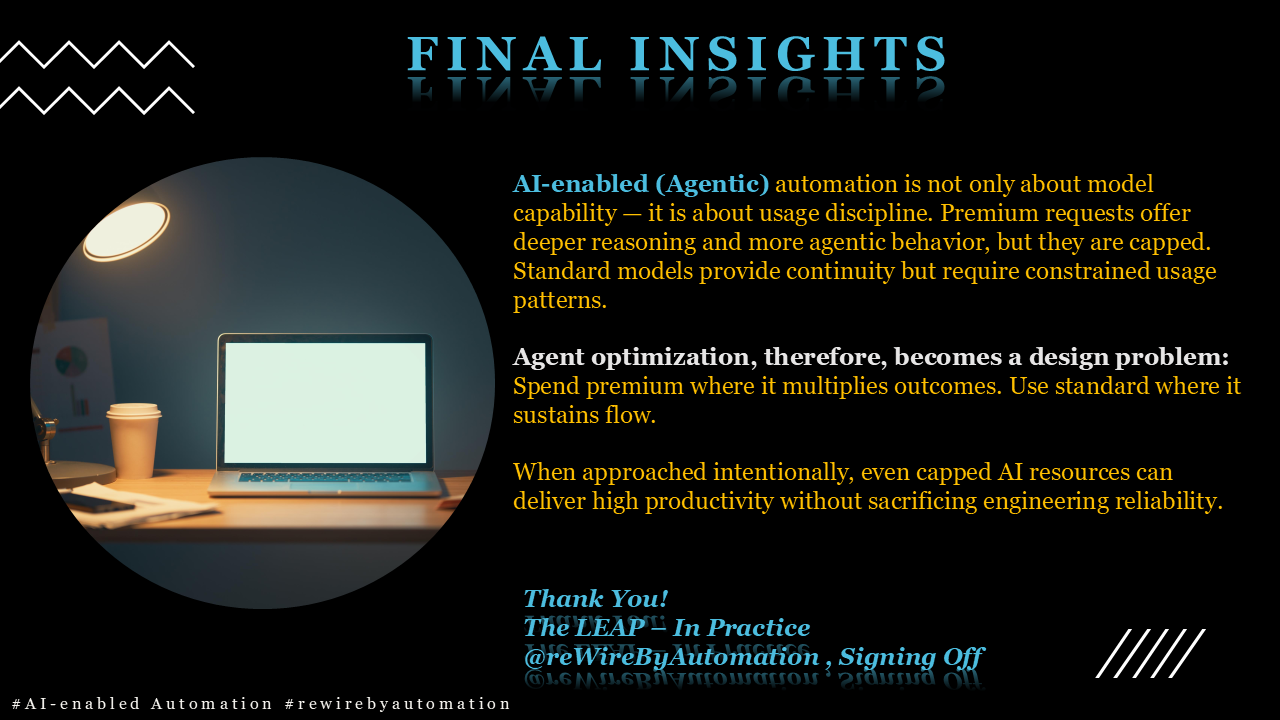
This creates a predictable development rhythm even when the premium quota is exhausted.


Stay tuned for the next article from rewireAdaptive portfolio
This is @reWireByAutomation, (Kiran Edupuganti) Signing Off!
With this, @reWireByAutomation has published a “Agent Optimization: Designing a Premium-First, Standard-Safe Workflow"