Note: This portfolio site was launched on 30th March 2025. More stories, resources, and portfolio updates will be added progressively as I move forward and subject to available personal time.
Agent Intelligence: Enabling Automation Through Value-Driven Documentation
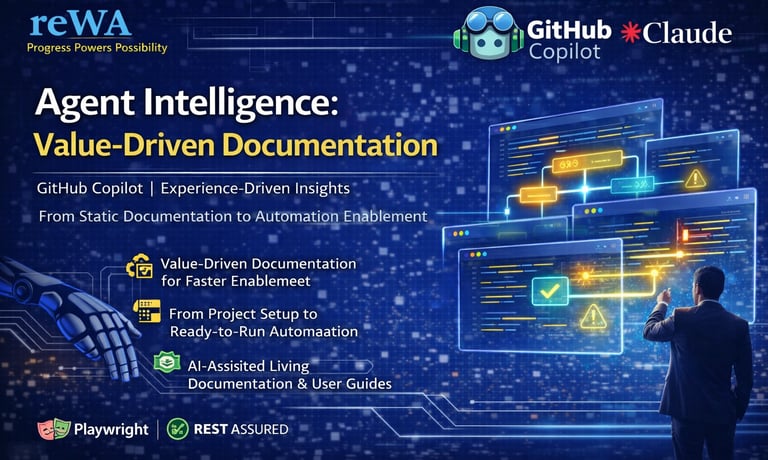
Agent Intelligence: Enabling Automation Through Value-Driven Documentation explains how structured, practical, and AI-assisted documentation reduces onboarding time, improves adoption, and enables automation systems through real-world implementation practices and engineering discipline.
TECHNICAL
Kiran Kumar Edupuganti
3/28/20265 min read






Agent Intelligence: Enabling Automation Through Value-Driven Documentation
GitHub Copilot , Claude | Experience-Driven Insights
Human-in-the-Loop Engineering
From Static Documentation to Automation Enablement
The portfolio reWireAdaptive, in association with the @reWirebyAutomation channel, presents an article on Agent Intelligence for Documentation. This article, titled "Agent Intelligence: Enabling Automation Through Value-Driven Documentation", aims to explore and adopt Agent Intelligence in documentation.
Introduction
Documentation is one of the most overlooked aspects of automation engineering. In most projects, the primary focus is on building automation scripts, achieving execution stability, and meeting delivery timelines. Documentation is often postponed, deprioritized, or handled as a one-time activity.
In real-world scenarios, especially in legacy projects, documentation is either missing or no longer aligned with the current state of the system. Automation frameworks may continue to run successfully, but the knowledge required to understand and use them is limited to a few experienced team members.
Common situations observed across projects include:
•frameworks that run but have no setup documentation
• outdated documents that do not match the current implementation
• onboarding dependent on verbal guidance or internal knowledge sharing
• repeated explanations of the same setup and execution steps
• difficulty in scaling automation usage across teams
These challenges do not stop execution, but they significantly affect team productivity, onboarding speed, and long-term maintainability.
In the AI-enabled engineering environment, documentation must evolve. It should not be treated as static content created after implementation. Instead, it should become a core engineering component that enables automation systems to be easily understood, executed, and extended.
This article explores how value-driven documentation, supported by Agent Intelligence, can transform documentation into an active enabler of automation systems.
The Documentation Gap in Automation Projects
The documentation gap is one of the most common issues in automation projects, especially in long-running systems. Over time, frameworks evolve, new modules are added, configurations change, and execution environments are updated. However, documentation often does not keep pace with these changes.
Typical gaps observed in automation projects include:
• missing or incomplete setup instructions
• undocumented dependencies and environment configurations
• lack of clarity on how to execute tests locally or in CI/CD
• absence of framework structure explanation
• utilities and reusable components without documentation
As a result, engineers are forced to rely on alternative approaches such as:
• trial-and-error setup
• reviewing code to understand execution flow
• asking experienced team members for guidance
• referring to outdated or inconsistent documents
This creates a system where knowledge is not centralized but distributed across individuals.
The impact of this gap is significant:
• increased onboarding time for new engineers
• inconsistent framework usage across teams
• higher support effort for experienced members
• reduced confidence in automation systems
Bridging this gap requires a shift from ad-hoc documentation to structured and value-driven documentation practices.
Value-Driven Documentation
Not all documentation is useful. In many projects, documents are created for completeness but are rarely used by engineers during day-to-day work.
Value-driven documentation focuses on practical usability rather than volume. It aims to provide exactly the information needed to perform specific tasks efficiently.
Effective documentation should answer key questions such as:
• How do I set up this project?
• How do I execute tests locally?
• How is the framework structured?
• How can I add a new test scenario?
• How do I troubleshoot common issues?
Value-driven documentation emphasizes:
• Clarity over length
• Task-oriented guidance
• Alignment with actual implementation
• Continuous updates as the system evolves
Instead of long descriptive documents, it focuses on actionable instructions and real usage scenarios.
When documentation is designed with value in mind, it becomes a daily tool for engineers, not just a reference document.
Zero to Project-Enabled Documentation
One of the most important objectives of documentation is to enable engineers to move from zero knowledge to active contribution in the shortest possible time.
A new engineer joining a project should be able to:
• Clone the repository
• Install required dependencies
• Configure environment settings
• Execute automation suites
• Understand basic framework structure
This requires a well-defined documentation flow that includes:
• Step-by-step setup instructions
• Environment configuration details
• Execution commands for different scenarios
• Expected outputs and logs
Zero-to-project-enabled documentation ensures that engineers do not spend excessive time understanding basic setup requirements.
It also reduces dependency on senior team members for onboarding support and helps maintain consistency in how the framework is used across teams.
knowledge to active contribution in the shortest possible time.
A new engineer joining a project should be able to:
• Clone the repository
• Install required dependencies
• Configure environment settings
• Execute automation suites
• Understand basic framework structure
This requires a well-defined documentation flow that includes:
• Step-by-step setup instructions
• Environment configuration details
• execution commands for different scenarios
• expected outputs and logs
Zero-to-project-enabled documentation ensures that engineers do not spend excessive time understanding basic setup requirements.
It also reduces dependency on senior team members for onboarding support and helps maintain consistency in how the framework is used across teams.
Repository-Level Documentation (README as Entry Point)
The repository README is the most critical piece of documentation in any automation project. It acts as the first interaction point for engineers and provides an overview of how to work with the system.
A well-designed README should include:
• project overview and purpose
• prerequisites such as tools and dependencies
• setup and installation steps
• execution commands for local and CI environments
• explanation of framework structure
• references to additional documentation
The README should be:
• simple and easy to follow
• concise but complete
• aligned with current implementation
• regularly updated
When maintained properly, the README becomes a single source of truth for getting started with the automation framework.
It reduces confusion, improves onboarding speed, and ensures that engineers can quickly begin working with the system.
From Traditional User Guides to AI-Generated Documentation
Traditional documentation approaches rely heavily on manual effort. User guides are written manually and often become outdated as the system evolves.
With AI-assisted tools, documentation can become more dynamic and aligned with the actual implementation.
AI can support documentation by:
• generating setup instructions based on project configuration
• summarizing framework structure from code
• explaining test scenarios from BDD feature files
• generating API documentation from request definitions
• updating documentation based on code changes
For example:
• generating quick-start guides directly from repository configuration
• summarizing API test flows using existing request definitions
• creating scenario explanations from BDD feature files
• producing onboarding guides for new engineers
AI-assisted documentation reduces manual effort and improves consistency. It ensures that documentation evolves alongside the system.
However, it is important to validate AI-generated content to maintain accuracy and relevance.
Human-in-the-Loop Documentation Discipline
Even with AI-assisted capabilities, documentation requires human oversight. AI can generate content quickly, but it cannot fully understand project-specific nuances or business requirements.
Engineers are responsible for:
• validating AI-generated documentation
• ensuring accuracy and clarity
• aligning documentation with actual implementation
• maintaining consistency across documents
Human-in-the-loop discipline ensures that documentation remains:
• accurate
• practical
• aligned with engineering needs
AI accelerates documentation creation, but human validation ensures its quality.


Stay tuned for the next article from rewireAdaptive portfolio
This is @reWireByAutomation, (Kiran Edupuganti) Signing Off!
With this, @reWireByAutomation has published a “Agent Intelligence: Enabling Automation Through Value-Driven Documentation."