Note: This portfolio site was launched on 30th March 2025. More stories, resources, and portfolio updates will be added progressively as I move forward and subject to available personal time.

Agent Intelligence: Designing Observability for Open-Source Automation
Agent Intelligence: Designing Observability for Open-Source Automation explores how execution history, AI-assisted log analysis, and pattern detection enable platform-independent observability for automation systems through practical engineering insights and disciplined implementation.
TECHNICAL
Kiran Kumar Edupuganti
3/7/20265 min read
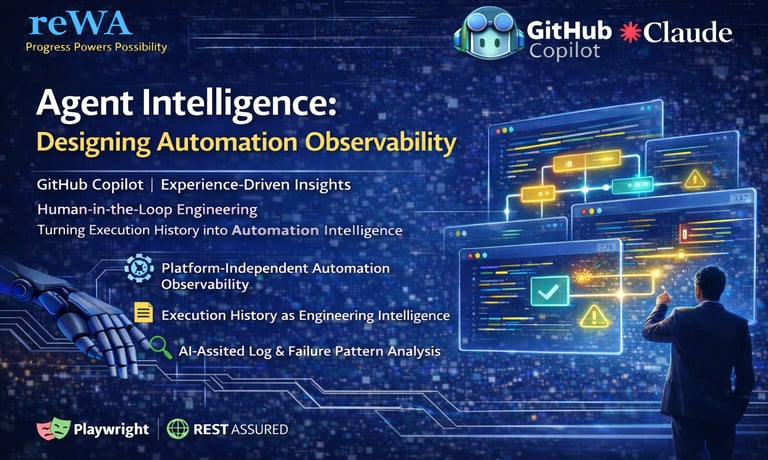





Agent Intelligence: Designing Observability for Open-Source Automation
GitHub Copilot , Claude | Experience-Driven Insights
Human-in-the-Loop Engineering
Turning Execution History into Automation Intelligence
The portfolio reWireAdaptive, in association with the @reWirebyAutomation channel, presents an article on Agent Intelligence of Observability. This article, titled "Agent Intelligence: Designing Automation Observability", aims to explore and adopt Agent Intelligence in the Opensource Automation.
Introduction
Automation frameworks generate large amounts of execution data every day. Each test execution produces logs, results, error messages, execution timings, and system responses. In many teams, this information is used only when a failure occurs. Engineers open the logs, analyze the error, fix the problem, and move forward.
However, this approach leaves a large amount of useful information unused. Execution history is not just a record of what happened. It can also provide valuable signals about system behavior, test stability, and framework design.
Commercial testing platforms often provide built-in observability features. These platforms show dashboards, failure analytics, trend reports, and stability metrics. This helps teams quickly understand how their automation systems are behaving over time.
Open-source automation frameworks such as Playwright, RestAssured, Selenium, Cypress, and Appium focus mainly on automation and test execution. They do not provide strong observability capabilities by default. Engineers must analyze logs manually or rely on external reporting tools.
With the support of Agent Intelligence and AI-assisted analysis, open-source automation frameworks can also build strong observability capabilities. Execution history can be transformed into engineering intelligence that helps improve automation reliability and framework design.
Why Observability Matters in Automation
Observability means understanding how a system behaves by analyzing the information it produces. In automation systems, this information includes test execution results, logs, timing metrics, and failure patterns.
Without observability, teams often face the same problems repeatedly. Failures appear unexpectedly, flaky tests remain difficult to identify, and engineers spend time investigating issues that have already occurred before.
Observability allows teams to understand patterns instead of looking at isolated failures. When execution history is analyzed properly, engineers can identify long-term signals that indicate deeper problems within the automation system.
Important benefits of observability include:
• Understanding long-term execution behavior
• Detecting repeated failure patterns
• Identifying unstable test cases
• Recognizing infrastructure-related issues
• Improving reliability of automation frameworks
Instead of reacting to individual failures, observability allows teams to look at the bigger picture and improve automation systems systematically.
Observability in Commercial Testing Platforms
Many commercial testing platforms provide observability capabilities as part of their product ecosystem. These platforms collect execution data automatically and convert it into dashboards and analytical insights.
Typical features available in these platforms include:
• Execution trend dashboards
• Historical pass and fail analysis
• Flaky test detection
• Retry pattern monitoring
• Environment-specific failure tracking
• Test stability metrics
These features help teams quickly understand which tests are unstable, which modules are failing frequently, and how automation systems behave across multiple runs.
However, these solutions are tied to specific platforms. Teams must rely on the capabilities and limitations of those platforms. While they provide useful analytics, they also create platform dependency.
Organizations using open-source automation frameworks often do not have the same level of built-in visibility.
The Observability Gap in Open-Source Automation
Open-source automation frameworks provide strong capabilities for writing and executing automated tests. They are widely used across industries because they are flexible, extensible, and integrate easily with CI/CD.
Examples include:
• Playwright for web automation
• RestAssured for API automation
• Selenium for browser automation
• Cypress for frontend testing
• Appium for mobile automation
While these frameworks are powerful for execution, they rarely provide deep analytics or observability capabilities.
Typical open-source automation frameworks provide:
• test execution
• logs and error messages
• reporting outputs
But they do not automatically provide:
• long-term execution analytics
• failure pattern detection
• trend-based insights
• automation stability monitoring
As a result, engineers often analyze failures manually. This makes it difficult to detect recurring patterns across multiple runs.
Agent Intelligence for Open-Source Observability
Agent Intelligence introduces a new approach to analyzing automation execution data. Instead of treating logs as raw output, AI-assisted tools can interpret logs, detect patterns, and summarize signals from historical executions.
This allows engineers to convert execution history into useful insights.
Agent Intelligence can assist with tasks such as:
• analyzing execution logs
• summarizing failure causes
• grouping similar errors across multiple runs
• identifying recurring instability patterns
• detecting unusual execution behavior
For example, AI-assisted analysis may detect patterns such as:
• repeated timeout failures in specific modules
• authentication failures across multiple test runs
• environment-related instability
• performance degradation in certain test cases
By analyzing execution history with AI support, engineers can identify trends that may not be visible during manual log review.
Execution History as Engineering Intelligence
Every automation run produces data that can help engineers improve their systems. Execution history includes valuable information that reflects how automation frameworks behave over time.
Examples of useful execution signals include:
• pass and fail trends across builds
• retry behavior of specific tests
• execution duration changes
• recurring error messages
• environment-specific failures
When analyzed consistently, this data helps engineers understand where automation systems are stable and where improvements are required.
Execution history can help teams identify:
• unstable test modules
• synchronization issues
• slow API responses
• infrastructure problems
• framework design weaknesses
Instead of analyzing failures individually, engineers can use historical patterns to improve automation architecture.
Flakiness Detection Through Pattern Analysis
Flaky tests are a common challenge in automation frameworks. A flaky test may pass during one execution and fail during another, even though the system behavior has not changed.
Common causes of flaky tests include:
• unstable locators
• synchronization problems
• inconsistent test data
• environment timing issues
• dependency on external services
When flaky tests are analyzed individually, engineers may struggle to find the root cause. Observability allows teams to detect flaky behavior by analyzing patterns across multiple executions.
Execution trend analysis helps detect:
• tests that fail intermittently
• high retry rates
• inconsistent execution durations
• environment-dependent instability
By observing these patterns over time, engineers can identify structural problems in automation frameworks rather than addressing failures one at a time.
Human-in-the-Loop Observability
AI tools can analyze execution logs and detect patterns quickly. However, automation observability still requires human judgment to interpret the results correctly.
Engineers play an important role in:
• validating AI-generated insights
• correlating failures with system behavior
• identifying the root cause of instability
• deciding how to improve automation design
AI tools assist in analyzing large amounts of data, but engineering decisions must remain guided by human expertise.
Human-in-the-loop engineering ensures that automation improvements remain reliable and practical.
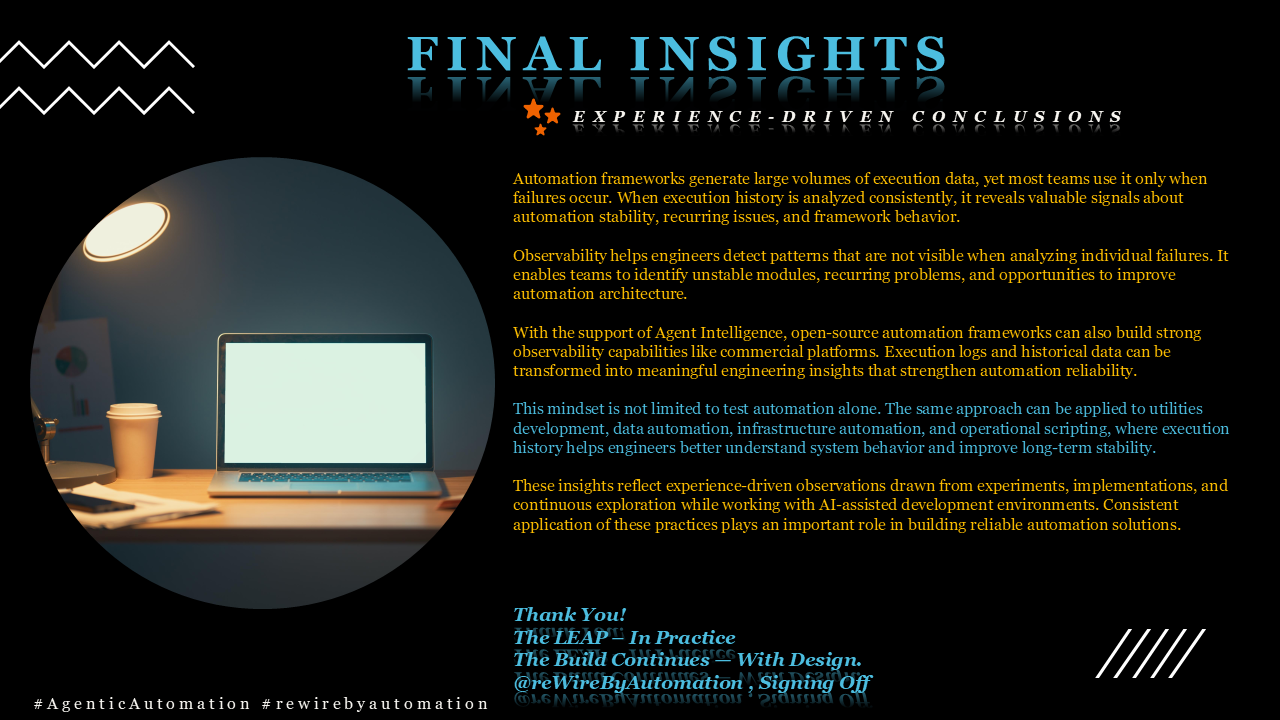
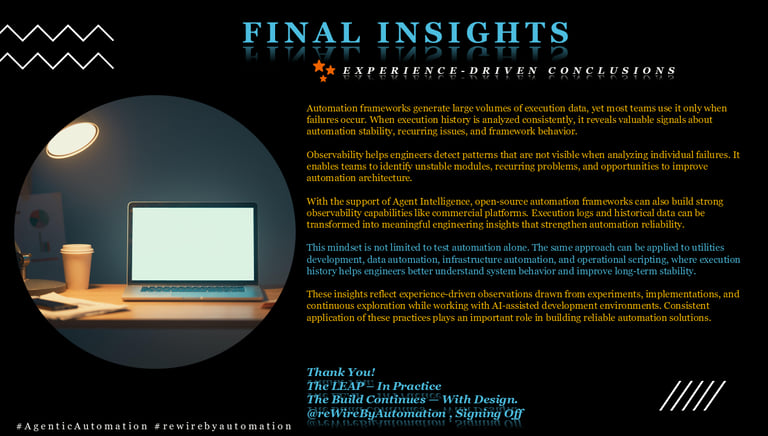


Stay tuned for the next article from rewireAdaptive portfolio
This is @reWireByAutomation, (Kiran Edupuganti) Signing Off!
With this, @reWireByAutomation has published a “Agent Intelligence: Designing Observability for Open-Source Automation"