Note: This portfolio site was launched on 30th March 2025. More stories, resources, and portfolio updates will be added progressively as I move forward and subject to available personal time.

Agent Intelligence: Coverage Intelligence for Product Quality
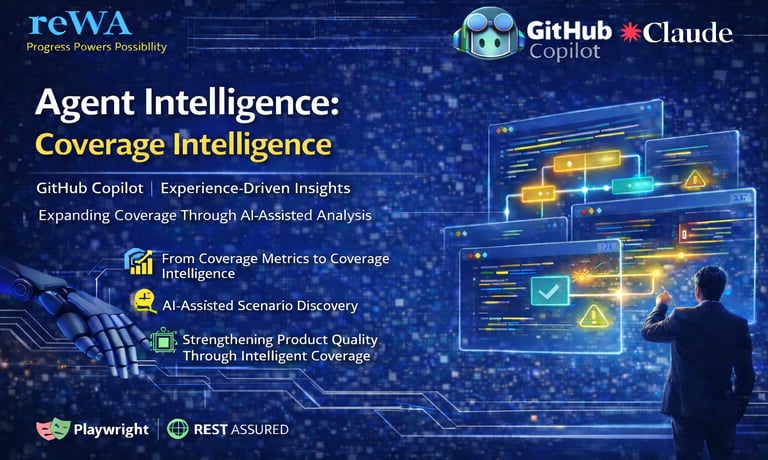
Agent Intelligence: Coverage Intelligence for Product Quality explores how AI-assisted analysis helps identify coverage gaps, expand scenario exploration, and strengthen product quality through intelligent interpretation of automation artifacts and execution data.
TECHNICAL
Kiran Kumar Edupuganti
3/15/20266 min read






Agent Intelligence: Coverage Intelligence for Product Quality
GitHub Copilot , Claude | Experience-Driven Insights
Human-in-the-Loop Engineering
Expanding Coverage Through AI-Assisted Analysis
The portfolio reWireAdaptive, in association with the @reWirebyAutomation channel, presents an article on Agent Intelligence for Coverage. This article, titled "Agent Intelligence: Coerage Intelligence for Product Quality", aims to explore and adopt Agent Intelligence in the Test Coverage.
Introduction
Test coverage has always been an important concept in automation engineering. Traditionally, teams measure coverage by mapping test cases to requirements or functional areas. When a feature is implemented, corresponding test cases are created and added to the automation suite. Over time, the regression suite grows, and coverage is assumed to improve as more tests are added.
However, test coverage is often interpreted mainly through metrics such as the number of test cases or the percentage of requirements mapped to tests. While these indicators provide structure and visibility, they do not always reflect whether the automation suite truly covers system behavior effectively. Modern software systems are increasingly dynamic. APIs support multiple request variations, user interfaces evolve frequently, and integrations introduce new edge conditions. Simply increasing the number of automated tests does not guarantee meaningful coverage. With the support of Agent Intelligence and AI-assisted analysis, automation teams can rethink how coverage is evaluated and expanded. AI tools can analyze existing automation artifacts, execution patterns, and system documentation to identify potential coverage gaps.
This approach enables engineers to move from traditional manual coverage tracking toward AI-driven coverage analysis, improving the depth and effectiveness of automation systems.
Traditional Coverage in Automation
In most automation projects, coverage is defined through structured planning and manual test design. Engineers review product requirements or user stories and create test scenarios that validate expected system behavior.
Typical coverage activities include:
• Requirement-to-test mapping
• Feature-based scenario design
• Regression suite development
• Functional validation across modules
Automation frameworks execute these scenarios repeatedly across builds, environments, and releases.
Teams often track coverage using indicators such as:
• Number of automated test cases
• Percentage of requirement coverage
• Size of regression suites
While these metrics provide visibility into testing progress, they do not always reveal whether the automation suite truly explores system behavior in depth.
In many projects, coverage grows gradually as new tests are added for new features. However, this incremental growth may lead to repeated validation of similar scenarios while other important cases remain untested.
The Coverage Gap in Automation Systems
Even large automation suites can contain hidden coverage gaps. Over time, test suites grow in size, but growth does not necessarily guarantee meaningful coverage.
Common coverage gaps include:
• Repeated tests validating similar scenarios
• Limited exploration of negative conditions
• Incomplete validation of API responses
• Missing boundary condition testing
• Weak assertion coverage
For example, API automation may validate only successful responses but may not fully test alternate responses such as invalid inputs, permission errors, or partial data responses.
Similarly, UI automation may focus mainly on primary user flows while overlooking variations in user behavior or unexpected system states.
These gaps are difficult to detect when coverage is measured only through test counts or requirement mapping. Engineers often identify them only after defects appear in production environments.
This highlights the need for a more analytical approach to understanding automation coverage.
AI-Assisted Coverage Analysis
AI-assisted tools introduce new ways to analyze automation systems and detect potential coverage gaps. Instead of relying only on manual inspection, engineers can use AI tools to review existing automation artifacts and execution outputs.
AI analysis can examine test scenarios, logs, response patterns, and system documentation to identify opportunities for improving coverage.
Examples of AI-assisted insights include:
• Detecting repeated test flows across different scenarios
• Identifying missing validation points in test assertions
• Suggesting additional edge-case scenarios
• Highlighting untested API response structures
AI can analyze automation artifacts at scale and identify patterns that are difficult to recognize through manual review.
For example, AI may reveal that several tests validate similar positive scenarios while negative cases remain largely unexplored. It may also detect that certain parameters or response conditions are never validated in existing tests.
These insights allow engineers to strengthen coverage more systematically rather than expanding test suites blindly.
Expanding Coverage Through AI Integration
AI integration enables automation engineers to expand coverage in a more intelligent and structured way. Instead of manually designing every scenario from scratch, engineers can use AI tools to analyze existing project artifacts and discover additional coverage opportunities.
AI can examine multiple sources that already exist in automation environments. By analyzing these sources, it can identify missing scenarios, suggest new validations, and highlight areas where coverage may be incomplete.
Several practical examples demonstrate how AI can assist coverage expansion.
API Endpoint Analysis Using Swagger or OpenAPI Specifications
Many API systems provide Swagger or OpenAPI specifications that describe endpoints, request parameters, and response structures. AI tools can analyze these specifications and compare them with existing API automation suites.
This analysis can identify:
• Endpoints that do not yet have automation coverage
• Optional parameters that are never tested
• Boundary value conditions for input parameters
• Missing negative test scenarios such as invalid inputs or authorization failures
This helps engineers expand API automation beyond basic success scenarios and cover a wider range of system behaviors.
Coverage Analysis Using Existing BDD Scenarios
BDD automation frameworks often organize scenarios within feature files. Over time, automation projects may accumulate large numbers of scenarios with similar patterns.
AI tools can analyze these BDD scenarios to detect:
• Repeated scenario structures
• Missing variations for existing workflows
• Incomplete validation steps
• Opportunities for additional negative scenarios
For example, if several scenarios validate successful login flows, AI analysis may suggest adding cases such as invalid credentials, session expiration, or role-based access variations.
UI Coverage Expansion Using User Stories
User stories and acceptance criteria describe expected user behavior and system interactions. AI tools can analyze user stories and compare them with existing UI automation scenarios.
This analysis may reveal:
• Acceptance criteria that are not covered by automation
• Alternate user flows not represented in tests
• Missing validations for UI states or error messages
This helps engineers ensure that UI automation coverage aligns more closely with the intended system behavior described in product documentation.
Test Suite Analysis Across Existing Automation Projects
Automation frameworks often contain test suites organized by modules or features. Some modules may accumulate extensive test coverage while others remain lightly tested.
AI tools can analyze the entire automation suite and identify:
• Modules with limited test coverage
• Redundant test flows across scenarios
• Areas where assertions are weak or incomplete
• Features validated only through positive scenarios
This allows engineers to expand automation coverage where it matters most.
Using AI as a Coverage Exploration Assistant
In these examples, AI serves as an exploration assistant rather than replacing test design. Engineers can use AI-generated insights to identify potential coverage opportunities and then apply engineering judgment to decide which scenarios should be implemented.
This approach enables automation teams to move from manual coverage expansion toward intelligent coverage exploration, strengthening automation quality while maintaining engineering discipline.
Manual Coverage vs AI-Driven Coverage
The difference between traditional coverage and AI-driven coverage lies primarily in how coverage opportunities are identified and analyzed.
Traditional Coverage AI-Driven Coverage
Manual test design AI-assisted scenario discovery
Requirement mapping Behavioral pattern analysis
Fixed regression suites Adaptive coverage expansion
Manual identification of gaps AI-assisted coverage analysis
Traditional coverage focuses on planned scenarios based on requirements. AI-driven coverage expands this by analyzing system behavior and automation artifacts to discover additional opportunities.
Both approaches remain important. AI enhances coverage exploration while engineers maintain control over test strategy and design.
Human-in-the-Loop Coverage Discipline
Even with AI-assisted analysis, automation engineers remain responsible for maintaining coverage discipline. AI tools may suggest new scenarios or identify potential gaps, but engineers must validate and prioritize these insights.
Human expertise is required to evaluate:
• System risk areas
• Business-critical scenarios
• Meaningful assertion coverage
•Mautomation maintainability
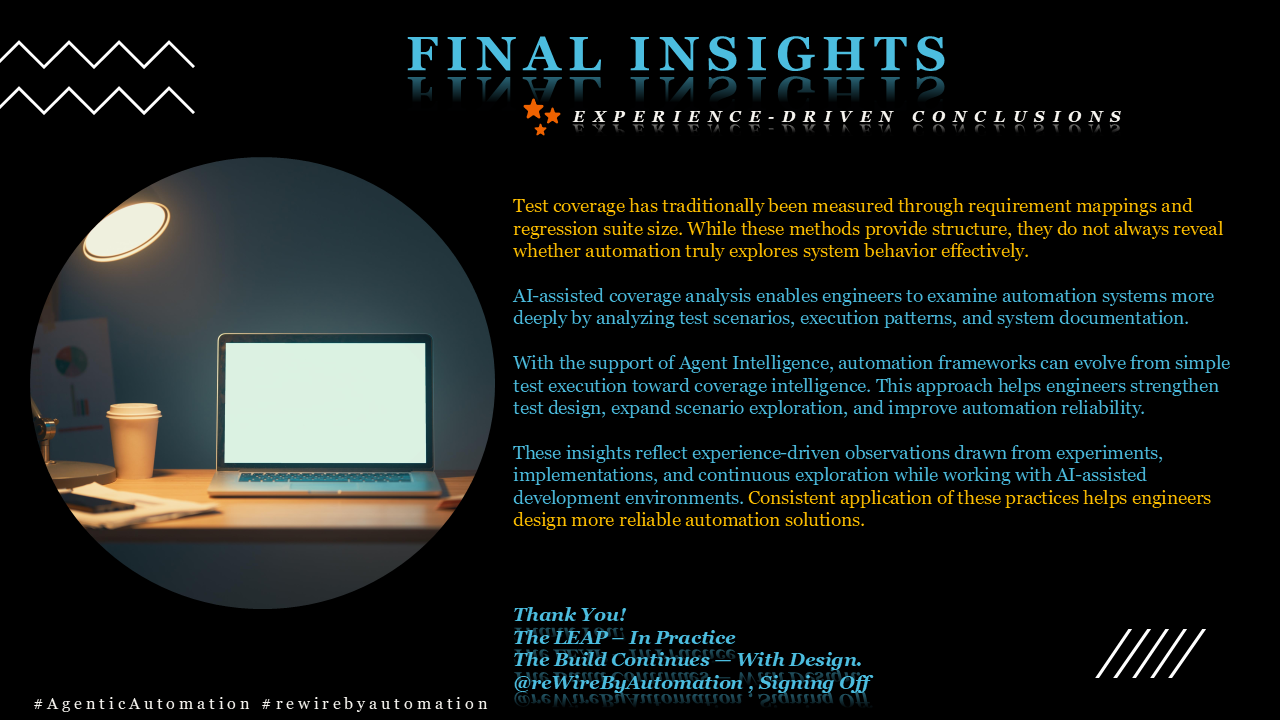
AI supports exploration and analysis, while engineers guide the overall coverage strategy.


Stay tuned for the next article from rewireAdaptive portfolio
This is @reWireByAutomation, (Kiran Edupuganti) Signing Off!
With this, @reWireByAutomation has published a “Agent Intelligence: Coverage Intelligence for Product Quality"