Note: This portfolio site was launched on 30th March 2025. More stories, resources, and portfolio updates will be added progressively as I move forward and subject to available personal time.

Agent Implementation: Rethinking Automation Design in the Age of AI
Exploring architecture-level thinking and design maturity in AI-enabled automation development, with practical insights on trade-offs, stability, and disciplined engineering across open-source automation ecosystems.
TECHNICAL
Kiran Kumar Edupuganti
3/1/20263 min read
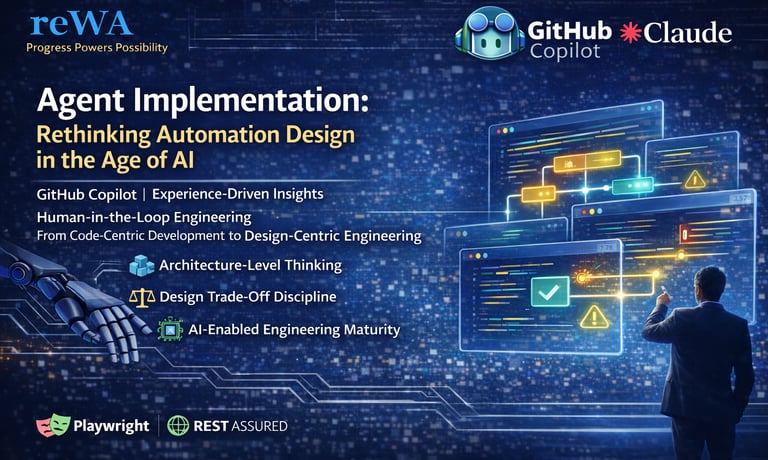






Agent Implementation: Rethinking Automation Design in the Age of AI
GitHub Copilot , Claude | Experience-Driven Insights
Human-in-the-Loop Engineering
From Code-Centric Development to Design-Centric Engineering
The portfolio reWireAdaptive, in association with the @reWirebyAutomation channel, presents an article on Agent Implementation. This article, titled "Agent Implementation: Rethinking Automation Design in the Age of AI", aims to explore and adopt Agent Implementation in the AI-Driven Automation Design.
Introduction
Automation engineering is evolving. Earlier, success was measured by whether scripts executed correctly and test suites passed. The main focus was implementation and stability. With AI tools integrated into development environments, automation design now requires a more structured and disciplined approach. AI can generate implementations, suggest improvements, and propose alternatives. However, this does not automatically improve system quality. The real change is not in coding speed, but in how carefully automation systems are designed.
This article explains why automation design must be rethought in the age of AI. The emphasis is on architecture-level thinking, design maturity, and disciplined evaluation of AI-generated solutions. These reflections are based on practical implementation and structured experimentation in open-source automation environments such as Playwright, RestAssured, and similar frameworks.
Traditional Automation Design Approach
Traditional automation development often follows a requirement-to-script model. Engineers interpret requirements, write scripts, execute them, and refine based on failures. Framework design evolves gradually as new needs arise.
Common characteristics include:
Script-first implementation
Utilities are added only after duplication appears
Limited architectural planning at the beginning
Local fixes instead of system-level review
Success is measured by execution stability
This works for smaller systems. However, as automation grows, weaknesses appear:
Tight coupling between modules
Inconsistent patterns
Duplicate logic
Increased maintenance effort
The limitation is not technical skill. It is the absence of deliberate architectural thinking.
Architecture-Level Thinking in the AI Era
AI-assisted development introduces a fundamental shift. When engineers describe a problem, AI can instantly propose multiple ways to implement it. This moves the focus from “how to code” to “how to design correctly.”
Architecture-level thinking requires defining structure before writing scripts. It includes:
Clear separation of responsibilities
Layered design for UI, API, and data components
Consistent abstraction patterns
Defined error-handling strategies
Stable configuration management
AI may generate functional code, but if architectural boundaries are unclear, the output can become inconsistent. Engineers must evaluate AI suggestions against predefined design principles.
Instead of asking, “Does this code work?” the better question becomes, “Does this strengthen the architecture?”
From Code-Centric Development to Design-Centric Engineering
In code-centric development, productivity is measured by the number of scripts completed. The focus is execution.
In design-centric engineering, productivity is measured by stability, scalability, and maintainability.
AI can generate working solutions quickly. However, not all working solutions are structurally sound. Design-centric engineering requires evaluating:
Reusability across modules
Alignment with framework standards
Long-term maintainability
Structural clarity
Instead of immediately accepting AI-generated code, engineers must consider its architectural impact.
AI accelerates implementation. An engineering discipline ensures sustainability.
Evaluating Design Trade-Offs in AI-Assisted Development
AI introduces multiple valid implementation options. Each option may solve the immediate problem, but long-term impact differs.
For example, AI might suggest:
Inline logic within a test
A reusable utility method
A wrapper abstraction
A modification in the base framework
All may function. The difference lies in scalability and maintainability.
Engineers must evaluate trade-offs such as:
Short-term simplicity vs long-term stability
Quick fixes vs reusable structure
Local optimization vs framework consistency
Performance vs readability
Design maturity is reflected in choosing the solution that strengthens the system, not just the one that works today.
AI expands possibilities. Engineering discipline filters them.
Design Stability in Open-Source Automation Frameworks
Open-source frameworks offer flexibility but require strong internal discipline. There are no enforced architectural guardrails. Engineers define structure.
In AI-assisted environments, unclear patterns lead to inconsistent outputs. A stable framework should include:
Clear folder organization
Defined naming conventions
Centralized utility layers
Consistent error-handling patterns
Separation of configuration and logic
AI performs best in structured environments. Clean design improves consistency and reduces future rework.
Human-in-the-Loop Engineering Discipline
AI-assisted development requires structured oversight. AI suggests. Engineers validate.
Human-in-the-loop discipline includes:
Reviewing logic correctness
Verifying business rule interpretation
Ensuring architectural alignment
Testing boundary cases
Maintaining framework consistency
AI improves efficiency. Human discipline ensures reliability.
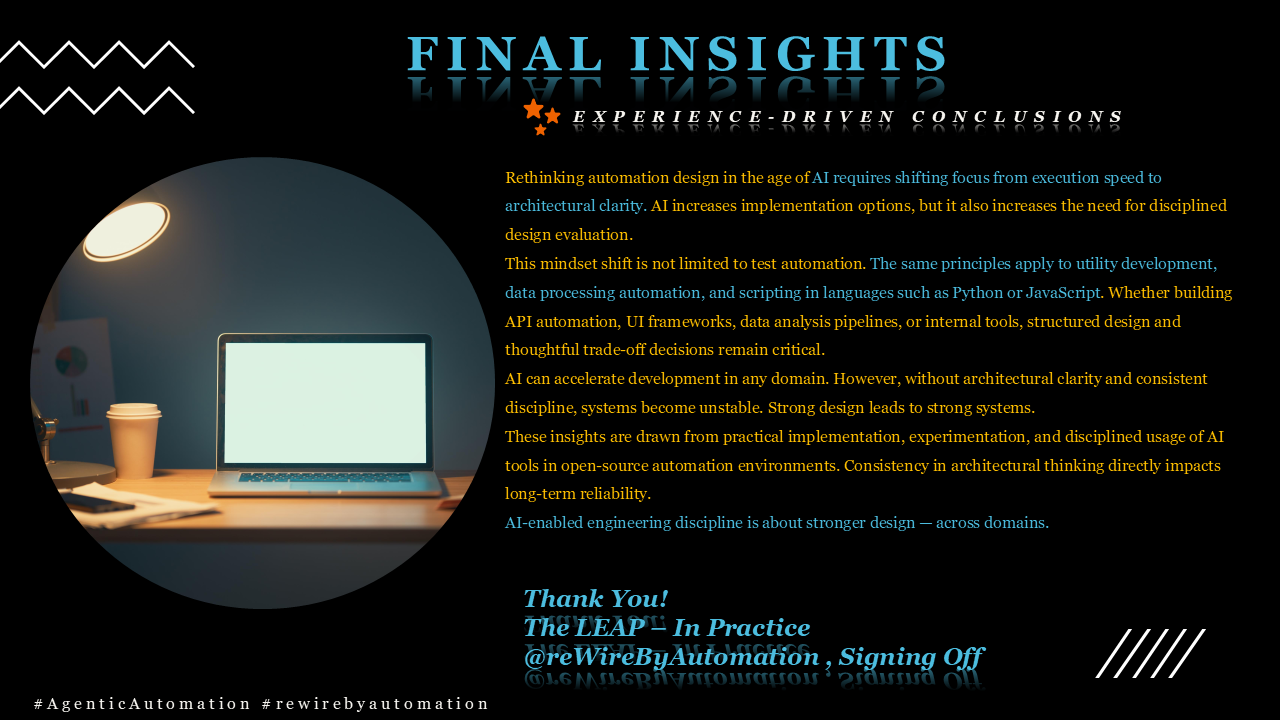


Stay tuned for the next article from rewireAdaptive portfolio
This is @reWireByAutomation, (Kiran Edupuganti) Signing Off!
With this, @reWireByAutomation has published a “Agent Implementation: Rethinking Automation Design in the Age of AI"