Note: This portfolio site was launched on 30th March 2025. More stories, resources, and portfolio updates will be added progressively as I move forward and subject to available personal time.

Agent Implementation: AI-Driven Failure Analysis in Agentic Automation
AI-driven failure analysis transforms traditional debugging into structured, context-aware intelligence. This article explores disciplined workflows, human-in-the-loop validation, and documentation reinforcement in open-source automation environments.
TECHNICAL
Kiran Kumar Edupuganti
2/23/20265 min read





Agent Implementation: AI-Driven Failure Analysis in Agentic Automation
GitHub Copilot | Experience-Driven Insights
Human-in-the-Loop Engineering
Shifting from Traditional Debugging to Intelligent Failure Analysis
The portfolio reWireAdaptive, in association with the @reWirebyAutomation channel, presents an article on Agent Implementation. This article, titled "Agent Implementation: AI-Driven Failure Analysis in Agentic Automation", aims to explore and adopt Agent Implementation in the AI-Driven Failure Analysis.
Introduction
This article explains how failure analysis evolves when automation development shifts into an AI-enabled environment. In traditional automation, debugging is event-driven, log-focused, and dependent on individual analysis skills. In agentic automation, failure handling becomes structured, context-aware, and supported by AI tools integrated into development workflows.
The concepts discussed here apply to any open-source automation framework such as Playwright, RestAssured, Selenium, Cypress, WebdriverIO, or custom-built systems. The approach is based on practical implementation experience while working with AI-enabled development and structured debugging workflows.
The focus of this article is to explain how AI-driven failure analysis improves clarity, reduces repeated effort, and builds stronger automation systems when supported by disciplined implementation practices.
Key focus areas:
Moving from event-driven debugging to structured failure analysis
Using AI tools for log summarization and root cause exploration
Maintaining human-in-the-loop validation
Building reusable failure intelligence
Reinforcing context through documentation
Why This Matters to the Test Automation Forum
In most open-source automation environments, failures are common. UI changes, API updates, environment differences, timing issues, and configuration shifts all contribute to instability. Debugging in such systems often consumes a large portion of development time.
Traditional event-driven debugging begins only after a failure occurs. Engineers review logs manually, inspect stack traces, compare changes, and attempt fixes. While effective, this process is repetitive and depends heavily on individual experience.
AI-enabled development introduces structured support. Failures can be summarized quickly. Patterns can be detected across multiple execution runs. Similar issues can be grouped. Potential root causes can be highlighted early.
This matters because teams using open-source automation need structured methods to improve debugging efficiency while maintaining control and reliability.
Why this is important:
Reduces manual log analysis effort
Improves clarity in understanding failures
Encourages structured debugging discipline
Prevents repeated investigation of similar issues
Supports faster stabilization of automation suites
Implementation Reality in Open-Source Automation
The approach discussed here is not tool-specific. It applies to any open-source automation stack.
In real-world automation projects, failures arise from multiple layers:
Assertion mismatches
Locator instability
API contract changes
Authentication or token issues
Environment configuration drift
Test data inconsistencies
AI-driven analysis helps process large volumes of failure data quickly. It can summarize long logs, correlate execution history, and identify patterns that may not be obvious during manual inspection.
Effective implementation requires structured prompts, clear context, and disciplined workflows.
Implementation characteristics:
Works across UI, API, and integration layers
Supports failure grouping and trend analysis
Requires structured context input
Improves over time with documentation reinforcement
Needs validation before code changes
Human-in-the-Loop Engineering
Human-in-the-loop engineering ensures that AI-generated insights are reviewed, validated, and applied carefully. AI tools can generate hypotheses and summarize patterns, but interpretation and decision-making remain controlled by the engineer.
Human validation ensures that:
Suggested fixes align with system specifications
Business rules are preserved
Assumptions are verified
Changes do not introduce instability
AI operates based on available context. If context is incomplete or unclear, output may be inaccurate. Human review maintains reliability.
Human-in-the-loop responsibilities:
Reviewing AI-generated root cause analysis
Confirming logical correctness
Approving final code changes
Updating documentation after resolution
Refining prompts for better future output
Human validation strengthens reliability and consistency.
Traditional Event-Driven Debugging vs AI-Driven Failure Analysis
Traditional event-driven debugging begins when a failure occurs. Engineers review stack traces, scan logs line by line, compare recent code changes, and attempt fixes based on experience. Each failure is often treated as a separate investigation, even if similar issues occurred earlier.
In this model, debugging is triggered by events. Historical execution data may not be analyzed systematically. Patterns across failures can remain unnoticed because logs are reviewed independently.
AI-driven failure analysis introduces structure. Instead of scanning logs manually, AI tools summarize key failure points. They identify repeated error patterns across multiple runs. They correlate failures with configuration or code changes. They generate root cause hypotheses based on available context and historical information.
Traditional event-driven debugging characteristics:
Manual log reading
Sequential error tracing
Trial-and-error fixes
Limited cross-run comparison
Knowledge retained at the individual level
Investigation triggered only after failure
AI-driven failure analysis characteristics:
Automated log summarization
Pattern recognition across executions
Root cause hypothesis generation
Context-aware comparison with previous failures
Structured reasoning supported by documentation
Trend-based investigation approach
This shift improves consistency and builds structured failure intelligence over time.
Failure Intelligence Workflow
Failure Intelligence Workflow is a structured method that transforms individual failures into reusable system knowledge. Instead of treating each failure as an isolated event, the workflow captures context, analyzes patterns, validates conclusions, and reinforces documentation for future accuracy.
This structured approach ensures that every failure contributes to improving the automation system.
Step 1: Failure Detection
A test fails during execution in any open-source automation framework.
Step 2: Structured Artifact Collection
Gather all relevant information:
Complete logs
Stack traces
Request and response data (for APIs)
Test inputs and parameters
Environment details
Execution history
Accurate artifact collection ensures complete analysis.
Step 3: AI-Assisted Contextual Analysis
Using AI tools integrated into IDEs:
Summarize the failure clearly
Identify probable root causes
Detect repeated patterns across executions
Highlight configuration mismatches
Compare with previously documented issues
This reduces manual log scanning and improves clarity.
Step 4: Human Validation
Engineer evaluates:
Accuracy of AI interpretation
Alignment with specifications
Impact of proposed changes
Risk of unintended side effects
Validation ensures safe and reliable implementation.
Step 5: Controlled Fix Implementation
Apply fixes in:
Test logic
Synchronization strategy
Assertions
Configuration files
API validation logic
Changes are implemented carefully and verified through reruns.
Step 6: Documentation and Context Reinforcement
After resolution:
Update the README or technical documentation
Record the root cause clearly
Document edge cases
Capture failure patterns
Note environment dependencies
This step strengthens future AI sessions and improves agent accuracy.
Failures become structured knowledge rather than repeated issues.
Document Analysis and Context Reinforcement
Document analysis plays a critical role in improving AI-assisted debugging accuracy. When documentation is structured and updated regularly, AI tools operate with stronger contextual understanding.
Well-maintained documentation supports:
Clear specification alignment
Reduced ambiguity
Improved AI response quality
Faster onboarding
Reduced repetition of resolved issues
Documentation updates should include:
Root cause explanations
Known edge cases
Environment dependencies
Test data constraints
Common failure patterns
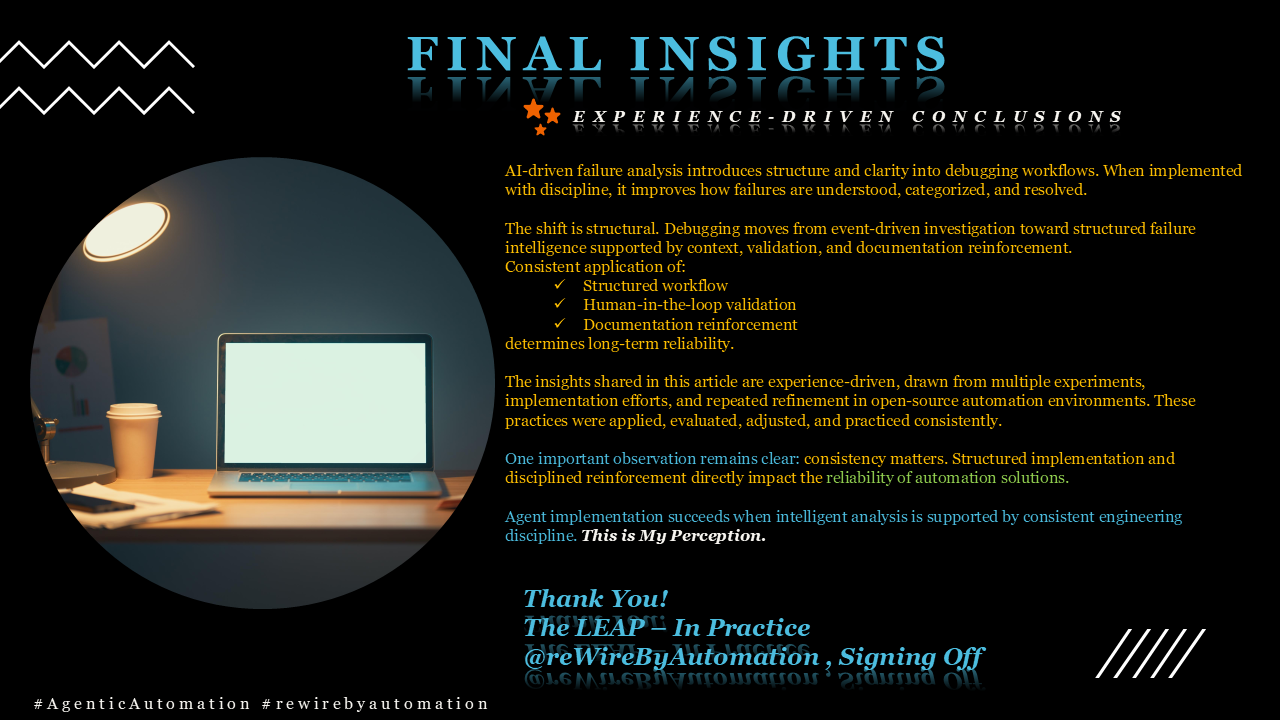
Over time, documentation becomes a context engine that supports intelligent debugging and increases solution reliability. – This is my perception


Stay tuned for the next article from rewireAdaptive portfolio
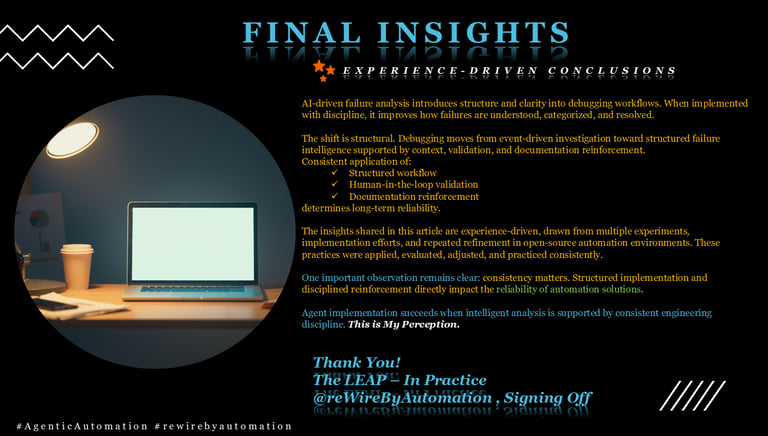
This is @reWireByAutomation, (Kiran Edupuganti) Signing Off!
With this, @reWireByAutomation has published a “Agent Implementation: AI-Driven Failure Analysis in Agentic Automation"